


Free Download The Man Who Mistook His Wife for a Hat: And Other Clinical Tales
The Man Who Mistook His Wife For A Hat: And Other Clinical Tales When composing can alter your life, when writing can enhance you by providing much cash, why do not you try it? Are you still extremely baffled of where getting the ideas? Do you still have no concept with just what you are going to compose? Currently, you will require reading The Man Who Mistook His Wife For A Hat: And Other Clinical Tales A great writer is an excellent user simultaneously. You can specify just how you create depending on what books to check out. This The Man Who Mistook His Wife For A Hat: And Other Clinical Tales could aid you to fix the trouble. It can be one of the ideal sources to create your composing ability.
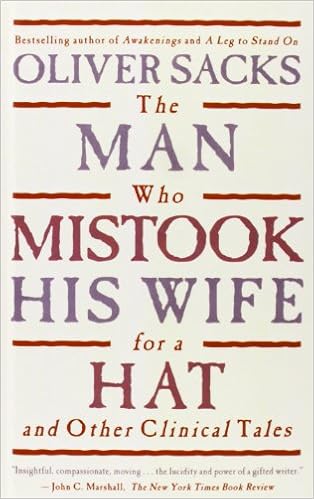
The Man Who Mistook His Wife for a Hat: And Other Clinical Tales

Free Download The Man Who Mistook His Wife for a Hat: And Other Clinical Tales
Reserve, truth close friend of yours while being in a lonesome time. Book, is a friend for you to come with when remaining in a hard time of work due date. Book is a manner that you need to hold day-to-day making much better future. When somebody is causing obtain many activities and also you have couple of times freely, it will certainly be much better for you to spend it wisely.
To satisfy individuals necessity regarding obtaining the book, we provide this site to visit. Not just to check out, can you likewise be the member of this website to get the brand-new updated publication daily. As below, we will certainly offer to you as the best The Man Who Mistook His Wife For A Hat: And Other Clinical Tales today. It is really fascinating to disclose that lots of people enjoy analysis. It implies that the requirements of guides will enhance. However, how has to do with you? Are you still spirit to finish your analysis?
This The Man Who Mistook His Wife For A Hat: And Other Clinical Tales belongs to the soft file book that we provide in this on-line website. You may find this kind of books and other collective books in this website actually. By clicking the link that we offer, you can go to the book site and enjoy it. Saving the soft file of this book becomes what you can overcome to read it everywhere. This way can evoke the break boredom that you can feel. It will also be a good way to save the file in the gadget or tablet, so you can read it any time.
So, all people who read The Man Who Mistook His Wife For A Hat: And Other Clinical Tales will seem like doing things by themselves. It depends upon how the readers stare and also think about this publication. Yet, commonly, it actually features the incredible thoughts of the book reading. It will certainly likewise give you the impressive systems of creativity. Of course, it will certainly serve you better idea of perfections. It is why we always provide you the most effective book that could make your life much better. Now, really feel the life to get the amazing ways of publication accomplishment.
Product details
Library Binding: 243 pages
Publisher: Paw Prints 2008-06-26; Reprint edition (June 26, 2008)
Language: English
ISBN-10: 1439503052
ISBN-13: 978-1439503058
Product Dimensions:
0.8 x 5.5 x 8.8 inches
Shipping Weight: 10.4 ounces
Average Customer Review:
4.2 out of 5 stars
775 customer reviews
Amazon Best Sellers Rank:
#1,479,104 in Books (See Top 100 in Books)
This is my first book by Oliver Sacks. I must admit I was expecting more science, less "novel." Dr. Sacks writes in a literary style and loves multiple complex sentences that make the argument indeed richer, but also intricate. So, if you want a simple reading, you'll be a little surprised.The book consists of four parts:1) Losses2) Execess3) Transports4) The World of the SimpleEach section relates to a different set of neurological problems resulting in a mental disorder.1) In the "Losses" the author describes nine cases."Neurology's favourite word is 'deficit', denoting an impariment or incapacity of neurological function: loss of vision, loss dexterity, loss of identity and myriad other lacks and losses of specific functions (or faculties)."2) In the "Execess" find five "stories"."What then of the opposite - an execess or superabundance of functions?"and next"... we consider their excesses - not amnesia, but hypermnesia; not agnosia, but hypergnosia; and all the other 'hypers' we can imagine."3) The chapter "Transports" describes six cases."...'transports' - often of poignant intensity, and shot through with personal feeling and meaning - tend to be seen, like drimes, as psychical: as a manifestation, perhaps, of unconscious or preconcious activity..."and next"...to be seen as psychoses, or to be brodcast as religious revelations, rather than brought to physicians."4) And at the end of "The World of the Simple" (four "stories"). Dr. Sacks describes cases of people whose neurological disorders outfitted with extraordinary abilities, such as "seeing the numbers," eidetic memory, an excellent sense of smell, etc. (Ie. brilliant savants).In his book, Dr. Sacks often refers to the study of well-known Russian psychologist A. R. Luria.Dr. Sacks style of reasoning, not everyone will like it. Besides, there are many similar books, though written from a different perspective than neurological such as "Tales from the Couch: A Clinical Psychologist's True Stories of Psychopathology" by Dr. Bob Wendorf.
Oliver Sacks was a neurologist who wrote several different best-sellers that delved into further understanding the capacity of the human brain. He wrote his best-sellers using his collection of cases of patients who suffered from different neurological conditions. Among one of his best sellers is the book The Man Who Mistook His Wife for a Hat and Other Clinical Tales where he compiled several of his most interesting clinical tales using his former patients that suffered from a variety of different neurological disorders. In his book, he divided the cases into four different categories; loses, excesses, transports, and simple. This review will further analyze the title of the book, the different neurological disorders that are divided into the four different categories which will then be reviewed categorially by analyzing the ways in which neuroscience is present in the book.For starters, the book title The Man Who Mistook His Wife for a Hat and Other Clinical Tales is extremely fitting because it conveys the essence of the book. The title allows for some curiosity on the reader’s behalf which entices them to read the book because they want to know what kind of neurological disorder prevents the patient from recognizing faces and mistaking their wife for a hat. Dr. Sacks quickly introduces us to the patient responsible of the title of the book during the first chapter. I think it’s fitting that Dr. Sacks chose Dr. P as his first patient as his book title because it sets the precedent to the rest patients in his collection of clinical tails. By introducing the person responsible for the title of the book in the first chapter, it doesn’t leave the reader wondering which patient mistook their wife for a hat. On the contrary, it helps set the tone for the rest of the clinical tales which shows stories about neurological disorders just as wild as Dr. P’s case.For the most part, the book was very well written and easy to understand. Since the book was divided into four different categories, it allowed for the book to be extremely organized because the cases either fell into a losses, excesses, transports and simple categories. The first part of the book is losses, where Dr. Sacks describes neurological disorders that have a certain kind of loss in their neurological functions. An example of a loss would be visual agnosia which in the case of Dr. P, it took away his ability to distinguish faces. Although Dr. P was unable to distinguish faces, he still found a way to continue his everyday life with minimal interruption by using the help of music to guide him in his life.Neuroscience is presented in Dr. P’s case excessively. Because Dr. P’s has the inability to recognize faces, it means that his thinking is more abstract and mechanical. Dr. P’s thinking is more computer like because his brain is classifying and categorizing the faces he sees. Dr. P’s case is a prime example of why it’s important for not only the brain to classify and categorize things, but also having continual judging and feeling. If any of these elements are missing in the human brain, people become computer like, just as Dr. P. When people suffer from visual agnosia, just as Dr. P, their life becomes entirely abstract and computational. Dr. Sacks claim regarding that such disorder makes patients computer-like is accurate and valid because after making that claim, he follows up with the reader by showing another brief case of visual agnosia which allows the readers to compare the two patients and understand how complex visual agnosia is.The second part of the book is excesses, where Dr. Sacks describes neurological disorders that have a superabundance’s of functions. An example of an excess would be Tourette’s syndrome which is when a person has an excess amount of nervous system energy which transpires into production of strange motions and notions such as tics, compulsions, and etc. In the case of Witty Ticcy Ray his Tourette’s was extremely debilitating because his tics were uncontrollable and unorthodox. It wasn’t until Witty Ticcy Ray got started on a new medication called Haldol which allowed him to live his life with minimal interruption with his illness by finding the proper dosage that worked for him.Neuroscience is presented in the case of Witty Ticcy Ray in several different ways. For starters, Dr. Sacks starts out by explaining that Tourette’s patients have disturbances in the instinctual bases of behavior in the brain. Such areas affected are the thalamus, hypothalamus, limbic system and amygdala which is where all the determinants for personality are located at. The presentation of neuroscience in the case of Witty Ticcy Ray makes sense with my understanding of neuroscience because it helped me understand how Tourette’s Syndrome works due to the fact that the areas affected are the areas that control personality which in turn with Tourette’s is expressed through different kind of ticks.Additionally, the treatment for Witty Ticcy Ray’s Tourette’s was a medication called Haldol. Haldol helped control his ticks and helped him assimilate into everyday life. Haldol works by helping to restore the balance of certain natural substances in the brain such as neurotransmitters. Dr. Sacks claims of Haldol working on Witty Ticcy Ray’s Tourette’s demonstrates a further understanding of neuroscience. The only thing I would have liked to see from Dr. Sacks argument about Haldol, would have been to have been provided with an elaborate explanation in the ways in which Haldol helps the neurotransmitters restore chemical balances in the brain.The third part of the book is transports, where Dr. Sacks describes neurological disorders of patients that suffer from altered perceptions which allows them to transport back to a moment in their past by reminiscing without notice. An example of transports which in the case of Mrs. O’C was caused by temporal lobe seizures due to a stroke the right temporal lobe. In the case of Mrs. O’C she was hearing Irish music in her head which filled her with personal feelings of her past which allowed her in a way to transport back to her childhood. Mrs. O’C Irish music in her head was resolved on its own with time but it shows how some neurological conditions are able to transport patients back to forgotten memories.Neuroscience is presented in the case of Mrs. O’C in various ways. For starters, it shows the impact of a stroke in the brain and because of the location of the stroke occurred in the right temporal lobe, it allowed for temporal lobe seizures to occur which was the reasoning behind hearing music and transporting to earlier memories. The presentation makes sense with my current understanding of neuroscience because from what I’ve learned in class it was that the temporal lobe is involved in primary auditory perception, such as hearing, and holds the primary auditory cortex. When Mrs. O’C had right temporal lobe seizures, it makes sense that she would hear music in her head. Dr. Sacks also followed up his claim by providing evidence of a test he ran on Mrs. O’C where he electrically stimulated the right temporal lobe and caused her to hear music. Which further proved his claim regarding the temporal lobe seizures and their impact on the human brain.The fourth part of the book is simple, where Dr. Sacks introduces several different patients who are considered “simple†because they suffer from different forms of mental retardation. Although Dr. Sacks labels these patients as “simple†they completely outgrow that label because Dr. Sacks brings out their personal strengths in each of their case and shows how these patients are able to thrive despite their neurological limitations.Neuroscience is presented in this final section by Dr. Sacks providing different case studies of patients who all live a simple and innocent lives due to their mental retardation. Although, their world might be simple; that doesn’t mean that their brain doesn’t work. Dr. Sacks did well presenting different patients which helped me understand the different ways that neuroscience works in the world of simple. The last case study of the section of simple shows the story of an Autistic boy named Jose who is referred to as “The Autistic Artist.†Although he was mentally retarded and unable to speak, that did not make him an imbecile because when asked to draw pictures, he drew those same pictures differently and amazingly. The argument that Dr. Sacks makes regarding the different skills of many different individuals with mental retardation and what they can achieve despite their limitations is backed up correctly and well explained by providing different examples of all the different patients.Altogether, Dr. Sacks collection of various different clinical tales makes for an interesting yet informative neuroscience read. Dr. Sacks effectively examines the personal side of neurosis by making his book an easy read by incorporating empathy with clinical jargon. Dividing the book into four separate parts allows for the reader to get an understanding of how different neurological diseases come in all shapes and sizes. Dr. Sacks effectively explains the concepts of losses in neuroscience, the concept of excesses, the concept of transports and the world of simple. All the different patients that were included in the different sections made it easier to understand the different neurological diseases being explained because it allowed the reader to see different examples of how neuroscience plays a giant role in our everyday lives.
The Man Who Mistook His Wife for a Hat: And Other Clinical Tales PDF
The Man Who Mistook His Wife for a Hat: And Other Clinical Tales EPub
The Man Who Mistook His Wife for a Hat: And Other Clinical Tales Doc
The Man Who Mistook His Wife for a Hat: And Other Clinical Tales iBooks
The Man Who Mistook His Wife for a Hat: And Other Clinical Tales rtf
The Man Who Mistook His Wife for a Hat: And Other Clinical Tales Mobipocket
The Man Who Mistook His Wife for a Hat: And Other Clinical Tales Kindle
0 komentar:
Posting Komentar